

Putting often decides whether a round feels accomplished or frustrating,yet many players refine their short game through rules of thumb instead of measurable principles. Synthesizing recent work from biomechanics and motor‑control science,this piece reinterprets evidence on grip,stance,alignment and stroke mechanics to foster reproducible contact and consistent distance control across varied greens and player anatomies. The focus is on quantifiable elements-face orientation at impact, the shoulder‑elbow pendulum, stroke timing and sensorimotor tuning-that research links to lower variability and better roll.
The material below links laboratory insights (motion‑capture kinematics, force‑plate data) with on‑course metrics (strokes‑gained, green‑reading error) to make laboratory findings practical. Scalable drills translate motor‑learning concepts-external focus, constrained variability training and progressive overload-into on‑green improvement. Diagnostic methods for uncovering individual error profiles and adaptable coaching cues that respect anatomical and learning differences are included. Grounded in peer‑reviewed work and field evidence, the aim is to give players and coaches a systematic approach for building a reliable putting stroke that produces observable scoring benefits.
Biomechanical Foundations of a Consistent Putting Stroke: Posture, Eye Alignment, and Pendulum Kinematics
Start by building a mechanically efficient address that creates repeatable contact and predictable ball launch. Aim for a small forward spinal inclination of roughly 15-25°, a knee bend near 10-20°, and a stance roughly equal to hip‑to‑shoulder width (about 30-35 cm/12-14 in) for most players. Place the ball around the center or slightly forward (0-1 inch) based on putter length so the head tracks neutral through impact; small adjustments in 1/4-1/2 inch steps help dial in roll with different shafts. Confirm eye position is over or no more than 2 in (5 cm) inside the target line-use a coin or plumb test on the practice green-since eye location affects perceived break and aiming decisions. Equipment belongs in the setup conversation: choose a putter length that lets you hinge from the shoulders comfortably (commonly 33-35 in for upright strokes), verify lie so the sole sits square, and remember that anchoring the putter is prohibited under the Rules of Golf, so posture and balance must support a free pendular stroke. Use this quick pre‑putt checklist to confirm consistency:
- Setup checkpoints: foot spacing, spine tilt, knee bend, ball placement, eye‑over‑line verification.
- Grip and pressure: soft grip pressure (~2-4/10) to avoid wrist tension and preserve shoulder rhythm.
- Putter face: square to the intended line with minimal launch loft at address (≈ 0-3°).
With setup steady, develop a shoulder‑driven pendular stroke so the putter swings about a stable shoulder axis with little wrist or forearm interference. Strive for proportionate backswing and follow‑through-short putts near a 1:1 backswing:follow‑through, and longer lag strokes scaled up while preserving the same shoulder rotation. A metronome or internal count (for instance 60-72 bpm on short‑to‑medium strokes) helps lock tempo and prevents late acceleration, producing more consistent ball speed-the dominant factor in avoiding three‑putts. Useful practice exercises include:
- Gate drill: set two tees a putter‑head apart to force a square face at impact.
- Shoulder mirror drill: use a mirror (or video) down the line to confirm shoulder rotation with minimal wrist motion.
- Clock drill (distance feel): holing putts at 3, 6, 9 and 12 ft to map backswing‑to‑distance relationships and log success rates.
Typical faults-early wrist breakdown,an overly steep takeaway,or lateral sway-respond to tempo reduction,shortening the stroke and re‑establishing the shoulder hinge.Track progress objectively by recording make percentages inside 6 ft and lag accuracy (target leaving the ball within a 3‑ft circle on long efforts) in practice sessions.
Translate biomechanical gains into course play by pairing a consistent pre‑shot setup with green‑reading that accounts for grain, wind and surface speed (many municipal/tournament greens run roughly 8-12 ft Stimpmeter; elite tournament greens often measure higher). Such as, on a long downhill putt on a slow green, shorten the backswing and use a firmer acceleration to prevent under‑rolling. Structure practice around measurable targets-such as 100 putts per session divided into 50 short (inside 6 ft), 30 mid (6-18 ft) and 20 long (18-40 ft)-and include situational drills like making 10 in a row from 6 ft or lagging to concentric rings (leave inside 3 ft from beyond 20 ft). Develop a compact pre‑putt routine to focus commitment: see the line, take one rehearsal stroke to confirm tempo, control breathing and commit. by linking posture, eye alignment and pendulum mechanics to specific drills, quantifiable practice goals and on‑course choices, golfers at every level can reduce variability, refine speed control and improve putting outcomes.
Optimizing Grip Pressure and Hand Position for Precision Control and Tactile Feedback
effective grip technique balances control with sensory feedback so the hands act as fine modulators of the putter rather than rigid clamps. For most full shots use a neutral to slightly stronger lead‑hand rotation; place the club primarily in the finger pads rather than deep in the palms so the fingers and pads take the load. On a 1-10 pressure scale,1-3 is ultra‑light (putting and delicate chips),4-6 moderate (irons and pitches),and 7-8 firm (into strong wind or when needed for stability); avoid pressures > 8 accept as an emergency fix. At address aim for a slightly bowed lead wrist and a modest forward shaft lean of about 5-10° on iron shots to encourage compressed, ball‑first contact; for putting the hands should be slightly ahead of the ball on the forward stroke with the shaft near vertical or tipped forward 0-5°. As always, equipment and technique must follow the Rules-anchoring is not permitted-so select grips and putting styles (including arm‑lock where legal) that preserve consistent tactile feedback.
Convert these principles into dependable mechanics via feel drills and on‑course adjustments. Start by contrasting pressures to train the nervous system: hold a mid‑iron at about 5/10 and make five half swings, then adopt a 3/10 grip and take five putter‑length strokes-this contrast conditions appropriate pressure for different shots. Try targeted drills:
- Grip‑pressure drill: tuck a towel under both armpits and perform 20 slow swings while keeping the towel in place to discourage excessive grip tightening and promote finger‑pad contact;
- Putting tactile drill: place a coin 6 ft from the hole and execute 30 putts at 2-3/10 pressure aiming to hole or leave the ball close on ~75% of attempts to refine roll vs impact speed;
- Short‑game control drill: chip to a 10‑ft circle alternating 4/10 and 2/10 grip intensity to learn when to firm up for spin and when to soften for bump‑and‑run.
Match grip pressure to conditions: raise pressure by roughly one level into heavy wind or thick rough but offset tension with controlled breathing and a shortened backswing. Common errors include the “death grip” (excessive tension causing hooks and distance loss) and palm‑dominant holds that inhibit wrist hinge; remedy these by moving the contact point toward the fingers and practicing 50 fingertip‑only swings until tempo and dispersion show measurable improvement (track dispersion radius or face‑angle variability with a launch monitor).
Extend grip and hand positioning into shot shaping, equipment selection and scoring targets. A stronger lead‑hand orientation typically closes the face and favors draws, while a weaker grip encourages fades-use this deliberately around doglegs or hazards. Equipment choices matter too: larger grip diameters can reduce wrist collapse and help players with pain or very fast tempos, whereas thinner grips can promote release and more spin; try incremental changes of 1-2 mm and assess outcomes with a launch monitor or scoring data. Set measurable goals-cut three‑putts by 30% in 8 weeks via consistent pressure drill practice and record putts per round; for approach dispersion aim to reduce fairway‑attempt spread by 10 yards through graded grip‑pressure control. Incorporate a short pre‑shot routine (deep breath, two practice swings at intended pressure, commit) to avoid pressure‑related grip creep. Offer alternatives for specific needs (cross‑handed or arm‑lock putting for limited wrist mobility; thicker grips for arthritis). By combining precise hand placement, graduated pressure control and context‑specific adjustments, players can raise consistency, lower scores and manage course strategy across conditions.
Establishing Reliable Tempo and Stroke Length Through Evidence Based Metronome and Distance Control drills
Tempo and stroke length require a clear, repeatable reference. Tempo is the timing relationship between backswing and forward stroke; many coaches and studies use a target of roughly a 2:1 backswing:forward ratio (two beats back,one beat through). Implement this with a metronome app set in a practical band (commonly 50-70 bpm for short‑to‑medium putts) and sync a shoulder‑driven pendulum to the clicks. Define stroke length relative to distance: use short strokes for 0-6 ft (≈1-3 in. shoulder rotation), medium strokes for 6-20 ft (≈3-8 in.), and long strokes for >20 ft where maintaining tempo and consistent acceleration is paramount. Core setup-feet about shoulder‑width, eyes over or slightly inside the ball, shaft tipped slightly forward and a square face-helps the metronome‑paced pendulum produce consistent face control and reduce loft changes that impair roll.
Progressive, measurable drills turn tempo concepts into reliable skills. Begin with an auditory metronome drill: set a cozy bpm and take 20 strokes from 3 ft, keeping the head on the beat and recording percentage that finish within a 12‑inch circle; then repeat at 6, 12 and 20 ft while preserving the tempo ratio. Add a distance ladder and gate alignment to confirm face control: 10 putts each from 3, 6, 12 and 20 ft with make/leave stats. Verify putter length and lie before practice, keep grip pressure under 5/10 to feel the pendulum without losing face control, and favour shoulder‑driven motion with minimal wrist collapse.If you decelerate through impact, shorten the backswing and slightly raise metronome bpm; if you flip or over‑use the wrists, place a small towel under both armpits to encourage shoulder cohesion. Make practice goals specific and trackable-for example,80% of 6‑ft putts finish within 12 in. across 50 attempts, or reduce three‑putts by one per round within four weeks-so progress is objective.
Bring tempo and distance control into on‑course decision making and the mental game. Rather than changing tempo between greens, most players benefit from keeping the same metronome timing while altering stroke length-on faster greens shorten the stroke, on slower greens lengthen it but retain the 2:1 rhythm. train uphill and downhill lag putting to learn how slope changes required stroke length and acceleration, and replicate pressure with match‑play style games on the practice green. Remember the rules of Golf: anchoring the putter is not allowed, so cultivate a free‑stroke routine consistent with the regulations. Use multiple learning modes-visual metronomes, audio beats and kinesthetic feel exercises (eyes closed drills)-to suit different learners. Mapping objective practice metrics to course situations (e.g., choosing conservative lag putts to avoid three‑putts on exposed greens) builds a tactical framework where steady tempo and calibrated stroke length increase one‑putt chances and overall scoring consistency.
Green reading and Speed Judgment: Integrating Surface Assessment with Visual Cues and Structured Decision Rules
Treat a putting surface as an integrated system: slope, grain, moisture and hole position together determine both line and required speed. Walk lines that let you view the putt from multiple perspectives-behind the ball, behind the hole and alongside the fall line-to locate the true high side and spot subtle crowns or ridges. Where practical, quantify slope (for example, a 1° slope over 20 ft deflects the ball ≈ 4.2 inches) and convert that into an aim‑point adjustment rather than relying solely on intuition. Use tactile input too-feel the turf under your shoes and look for grain cues (shine or color differences usually indicate grain direction; often grain runs toward the sun). Grain can speed or slow the ball depending on whether you’re hitting with or against it. Keep a compact, repeatable setup-face square to the start line, eyes over/just inside the ball, ball slightly forward for faster surfaces and a stable lower body-to isolate the pendulum stroke so the read and the execution interact predictably.
Once you’ve set the read, combine speed judgment with a dependable stroke model. Use a pendulum stroke with a baseline 1:2 backswing‑to‑follow‑through tempo and vary backswing length to control distance: on many flat, medium‑speed greens a 10-12 inch backswing will roll about 10-12 ft when the putter’s effective loft is in the 2-4° band. For lag putting prioritize pace over perfect line-aim to leave long putts 3-6 ft from the hole to cut three‑putt risk. Drills that improve these judgements include:
- clock drill: place balls at 3, 6, 9 and 12 ft around the cup and make consecutive putts to build distance feel;
- Ladder drill: putt from 5, 10, 15 and 20 ft back‑to‑back to fine‑tune backswing length to roll;
- Uphill/Downhill lag drill: hit 40-60 ft putts to a target zone on slopes to practice pace on variable breaks.
Typical mistakes-too much wrist, lifting the head early or over‑aiming for break-are corrected with video review, metronome practice and alignment rods to verify start line.
Convert technical proficiency into course strategy by combining appropriate equipment, consistent practice and mental routines. Match putter style to stroke (face‑balanced for straight‑back‑straight‑through, toe‑hang for arc strokes), and experiment with grip size and shaft length to stabilize wrists. A practical weekly plan might include:
- Pre‑round (10-15 min): 20 putts from 3 ft, 10 from 8-12 ft, and three long lag attempts aiming for a 3‑ft circle;
- Weekly session (30-60 min): 100‑putt challenge alternating short, mid and long distances, tracking make percentage and lag proximity; aim for 80-90% from 3 ft and reliably leaving long putts inside 6 ft.
On the course, play the high side when unsure to leave an uphill comeback and adjust choices for weather-wet greens reduce break and slow pace, while dry, sun‑baked surfaces increase both break and speed.finish with a short pre‑putt routine: one visual read, pick an aim point, a practice stroke at intended tempo, then execute. Integrating visual assessment,repeatable stroke control and course‑aware decision rules will lower three‑putts,sharpen lag performance and turn practice into lower scores across skill levels.
Progressive Practice Protocols and Drill Sequences to Maximize skill Transfer to On Course Performance
Design practice around the twin principles of specificity and purposeful practice: sessions should replicate the kinematics, speeds and decision demands players will face on course. Start with a brief warm‑up (5-10 minutes mobility, 10-15 short wedge swings and progressive fuller swings), then move into focused blocks targeting single technical goals-face control, path correction or distance control-before introducing variability. When isolating face control, for example, use an alignment‑rod gate and impact sequence: set rods to a 1-2 cm gate and take 50 slow swings focusing on a square face at impact, then 30 at ~75% speed and finish with 20 at full speed; a measurable aim is <±2° variation in face angle at impact.Alternate blocked practice for rapid acquisition with random practice to build adaptability; a useful session could be 30 minutes of single‑distance wedge practice followed by 30 minutes of mixed‑distance approaches to force in‑session decision making.
Progress from full‑swing mechanics into short‑game work with a logical drill order that preserves setup fundamentals and promotes consistent contact and spin. Begin each sequence with setup checkpoints-neutral grip (grip pressure ~ 4-5/10), ball positions (driver: ~1-1.5 ball diameters inside left heel; short irons: just left of center), shaft lean (≈ 2-4° forward at address), and weight distribution (≈ 55/45 lead/trail on the forward swing for irons). Then layer drills: half‑swing tempo work (metronome or 3:1 backswing:downswing rhythm), impact‑bag sequencing and landing‑zone wedge practice (pick a 10‑ft circle and hit 10 balls from 60, 40, 30 and 20 yds, logging first‑bounce proximity). Sample practice items to quantify improvement:
- Putting ladder: 10 attempts from 3, 6, 9 and 12 ft; target 80% makes at 6 ft.
- Half‑to‑full progression: 30 slow half swings → 20 three‑quarter swings → 20 full swings; monitor dispersion.
- Short‑game landing dots: 30 shots from 40, 25 and 10 yds; goal: 70% first‑bounce inside the zone.
Common errors-too much hand action on chips (fix by shortening arc and opening stance), early extension on irons (use a chair/towel drill to maintain spine angle) and inconsistent ball position (use a marked mat)-are corrected with targeted drills. Equipment choices like wedge bounce should match course conditions (lower bounce for firm turf, higher bounce for soft lies); confirm loft/lie with a fitter to ensure your setup supports desired contact and spin.
To convert technical gains into scoring improvement, simulate on‑course pressures and emphasize decision making, trajectory control and green reading. Include pressure drills-e.g., a 9‑hole simulated match where missed short putts incur penalties-and situational exercises (hit 10 low, penetrating 7‑iron shots into a 15-20 mph crosswind to practice club selection and trajectory control). For putting, use an aim‑point routine that combines fall‑line reading with a speed‑control clock: visualize the putt’s break ~2 seconds before addressing, then perform a pre‑shot ritual of 6-8 deep breaths, one alignment check and a single practice stroke. Set measurable on‑course targets-reduce three‑putts to fewer than two per 18 holes, or hit driver shots within a 30‑yard dispersion for mid‑handicappers. Incorporate mental skills-pre‑shot routines, breathing, process‑focused goals-so technical habits persist under pressure. In changing conditions (wet greens, firm turf, wind) prioritize percentage plays (lay up, use bump‑and‑run on firm greens) and always follow stroke‑and‑distance procedures when taking relief. Sequencing practice from isolated mechanics to mixed, course‑like scenarios helps players of all abilities achieve reliable transfer and measurable scoring gains.
Pre Shot Routine, Cognitive Strategies, and Pressure Management Techniques to Improve Performance under Stress
Begin every shot with a concise facts‑gathering and setup sequence that reduces performance variability under stress. First, evaluate lie, wind, pin location and hazard geometry, then pick a club and shot shape before stepping up. Adopt a repeatable physical setup: stance roughly shoulder‑width for full irons (slightly wider for driver), ball position ~ 2-5 cm inside the left heel for driver, mid‑to‑forward for long irons and centre for short irons and wedges, with a mild forward shaft lean (~ 4-6°) on iron strikes. Maintain grip pressure around 4-6/10 to allow functional wrist hinge and release. Use these quick checks to lock alignment:
- Clubface square to the intended line (use an alignment rod/toe line during practice to achieve ~1° accuracy);
- Spine tilt about 10-15° to establish a correct shoulder plane;
- Weight distribution centred for full swings and ≈ 60% on the front foot for controlled chips/bunker shots.
These steps build a biomechanical platform so that,when pressure rises,the body defaults to practiced patterns rather than improvisation.
Mental preparation is part of the same routine. Before initiating the backswing, hold a 3-5 second visualization of desired ball flight and landing, then choose a short process cue (e.g., “smooth,” “accelerate,” or a breathing anchor). Use box breathing (inhale 4s – hold 4s - exhale 4s – hold 4s) or similar to calm physiology and narrow focus, and keep the physical routine to ~ 20-30 seconds for routine shots to avoid overthinking. For putting, combine a fall‑line read with tempo rehearsal: visualize a 1-2 second roll to the hole and rehearse the backswing to match the intended speed; for a flat 10‑ft putt, try to finish the ball between 12 and 18 inches past the hole as an objective pacing target. Build pressure tolerance with graded stressors:
- competitive putting: make 10 consecutive putts inside 6 ft with a small penalty for misses;
- Shot‑selection games: play practice holes where conservative vs aggressive choices carry quantifiable scoring consequences;
- Simulated clock drills: shrink pre‑shot windows (20s → 15s → 10s) to train routine compression.
These cognitive techniques turn anxiety into structured processes that focus attention on task‑relevant cues rather than outcomes.
Link routine and mental skills to short‑game technique and course management so gains transfer to real rounds. For chips/pitches use a slightly narrower stance with the ball just back of centre,hands marginally ahead at setup and strike 1-2 cm behind the ball for dependable contact; practice 50 varied chips to 5,10 and 20 yards and log proximity,aiming to lift the share of shots finishing inside a 10‑yard circle from 50% to 70% within six weeks. For bunker play keep an open stance and accelerate through sand with a shallow entry; remember you may not ground the club in a hazard before the stroke.Use routine drills and troubleshooting:
- Gate drill for path control (tees just wider than the clubhead) to curb inside‑out swings;
- Impact tape and launch monitor feedback to quantify attack angle and spin for adjustments;
- Randomized practice sets (vary lie, wind and targets) to strengthen decision making and adaptability.
With precise setup metrics,cognitive anchors and targeted practice goals (e.g., cut three‑putts to under one per nine holes or improve wedge proximity as outlined), golfers from beginners to low‑handicappers can boost execution and scoring under pressure.
measuring Progress with Objective Metrics, Video Analysis, and Data Driven Adjustment Strategies
Start by creating an objective baseline using measurable metrics rather of impressions. Use a launch monitor (TrackMan, Flightscope) or validated tracking systems (Arccos, Shot Scope) to capture clubhead speed, ball speed, launch angle, spin rate, attack angle and distances over a sufficiently large sample (aim for at least 50 shots per club) to reduce random error. Parallelly track on‑course stats-Strokes Gained categories and putting figures-to see where strokes are being lost. Reasonable initial goals: for beginners, consistent wedge carry within ±10% and fewer than two three‑putts per nine; intermediate/low‑handicappers might aim to add 2-4 mph clubhead speed (≈ 5-10 yds extra carry) or tighten 7‑iron dispersion to within ±15 yds. Log environmental variables (wind, temperature and Stimpmeter readings) so you can normalize results across conditions and make meaningful comparisons over time.
Pair these quantitative measures with systematic video analysis to pinpoint faults and track kinematic change. Capture two synchronized angles-down‑the‑line and face‑on-from a tripod at hip height; record full swings at up to 240 fps and short‑game/putting strokes at 120-240 fps where possible to inspect impact dynamics and stroke repeatability. Use frame‑by‑frame review to measure address posture, shoulder plane, hip rotation, peak wrist hinge and impact shaft lean (for irons a forward shaft lean of ~ 4-6° frequently enough aids compression).Then apply data‑driven drills and checkpoints:
- Setup checkpoints: ball position relative to the lead heel, ~50-55% weight on the lead foot for irons, neutral grip pressure (~3-4/10).
- Tempo/sequencing drills: metronome protocol (backswing count 3 : downswing count 1) to improve sequence and limit early release.
- Impact drills: impact bag or towel under the trail arm to encourage correct extension.
- Putting drills: gate for face path, distance ladder (6, 10, 15, 20 ft) to quantify pace with targets like >60% from 6 ft and >30% from 10 ft.
compare video and metric data to your baseline repeatedly and make small, testable changes (e.g., adjust shaft lean by 1-2° or increase hip rotation ~10-15°), then re‑measure to confirm desired effects on ball flight and dispersion.
Turn measured gains into on‑course strategy and iterate with data‑driven updates. Prioritize practice to address the largest negative impacts on your strokes‑gained profile-if putting is the weakest link, emphasize short‑putt make rate and pace control until putts per round reach a target (e.g.,≤ 30 putts/round or a 20% reduction). When changing equipment, use objective A/B testing: compare two wedge loft/bounce configurations across 30 repeated chips to assess spin/launch, or roll 50 tests on a Stimpmeter‑measured surface to evaluate putter length/lie changes for consistent roll and alignment. Use your measured dispersion to guide course strategy-lay up to distances where your wedge accuracy is strongest instead of attacking risky pin locations-and practice situational scenarios you’re likely to face (windy uphill chips, firm lies, tournament Stimpmeter speeds around 10-12 ft). Run short feedback cycles of 4-8 weeks to reassess metrics, fine‑tune cues and reset measurable goals. This structured, evidence‑based loop merges technique, equipment and course management into continuous, verifiable improvement for players at every level.
Q&A
Q: What does the phrase “evidence‑based” mean in the context of putting instruction?
A: in this context “evidence‑based” refers to recommendations grounded in empirical findings from biomechanics, motor learning and applied sports science rather than solely anecdote. Practically this involves (1) quantifying putt and stroke variables (face angle, path, tempo, roll), (2) testing interventions with objective measurements, and (3) favouring approaches that produce consistent, repeatable gains across players and conditions. Linguistically, note that “evidence” is uncountable (use “no evidence” rather than “no evidences”) and idioms like “as evidenced by” are correct; avoid conflating speculation with demonstrated effects.
Q: What are the primary biomechanical principles that underlie a repeatable putting stroke?
A: The essentials are a stable lower body and torso,rotation from the shoulders (not wrists) to create a pendulum,minimising early wrist release or excessive hand action,and consistent putter‑face orientation at impact. Together these reduce variability in impact conditions (face angle, dynamic loft and speed), which governs roll direction and distance.
Q: how should a player select and adopt an optimal grip for putting?
A: Pick a grip that stabilises the hands relative to the shoulders so the stroke is shoulder‑driven. Conventional, cross‑hand and claw grips can all be effective if they limit wrist motion and improve face control.Individualise the choice with quantitative testing-measure stroke variability (face‑angle SD, path) and adopt the grip that lowers those metrics.
Q: What stance and alignment characteristics improve consistency?
A: Use a stance that lets you comfortably view the target line and ball, keeps weight balanced with minimal lateral sway, and positions the shoulders parallel to the intended swing plane. Foot width is personal-too narrow increases sway,too wide restricts shoulder rotation. Employ alignment rods or visual markers in practice to ensure the putter face, ball and target align repeatably.Q: What defines an optimal stroke path and face control for most golfers?
A: There are two broad stroke families: near‑straight back/through and slight‑arc. The crucial factor is minimizing face‑angle variability at impact and stabilising dynamic loft. Empirical work shows consistent face control at impact correlates more strongly with accuracy than insisting on one global path. Adopt the stroke that produces the lowest measured face‑angle variability for the individual.
Q: How significant is tempo and rhythm, and how should it be trained?
A: Tempo (relative duration of backswing vs downswing) and rhythm (regularity) are fundamental for speed control. Motor‑control research suggests stable temporal patterns reduce variability under pressure. use a metronome or auditory cues to set a repeatable pace (typical ratio 2:1 backswing:downswing) and practice progressively longer putts to calibrate pace. Emphasise feel and outcome feedback rather than over‑constraining mechanics once a stable tempo is established.
Q: What kinds of feedback and practice schedules produce the best transfer to on‑course performance?
A: Motor‑learning evidence supports a mix: begin with blocked practice for fast acquisition, then move to randomized practice for adaptability and transfer.Start with objective external feedback (launch monitor, video) and gradually reduce extrinsic cues so players develop intrinsic error detection. Introduce pressure elements (scorekeeping, time constraints) in practice to enhance transfer.
Q: What objective measures should coaches and players monitor?
A: Key metrics include putter‑face angle at impact, clubhead path, impact location on the face, dynamic loft, ball initial velocity and spin axis (to evaluate skid → roll), and temporal measures (backswing/downswing durations). These can be obtained via high‑speed video, pressure mats and putting analyzers; track variability and change rather than raw numbers alone.
Q: What drills reliably reduce common putting errors?
A: Effective,evidence‑informed drills include:
– Gate drill: narrow gate just wider than the putter to train a square face through impact.
– Pendulum metronome: stroke to a chosen tempo to stabilise rhythm.
– Distance ladder: putts from 3, 6, 9 and 12 ft to develop ballistic feel for speed.
– Mirror/face‑angle drill: camera or mirror feedback to monitor face angle.
– Clock drill: balls placed around the hole at set radii to train directional consistency.
Progression: 10-20 minutes per session, 3-5 sessions weekly, blending blocked and random practice.
Q: How should practice be structured over weeks and months for durable improvement?
A: Phase 1 (2-4 weeks): assessment and error reduction-establish baselines and use focused blocked practice with high feedback to eliminate major mechanical flaws. Phase 2 (4-8 weeks): consolidation-introduce random practice, reduce feedback and increase variability. Phase 3 (ongoing): transfer and resilience-simulate pressure and on‑course situations and keep periodic objective assessments. Short, frequent sessions (15-30 minutes) with deliberate targets outperform infrequent long sessions.
Q: How do psychological factors (attention,pressure) affect putting and how can these be trained?
A: Pressure can narrow attention or shift focus to explicit mechanics,often degrading performance. Train with implicit learning strategies (attend to ball roll outcome), pressure simulations (bets, time constraints) and gaze‑control techniques (quiet‑eye training) to maintain automaticity under stress. Varied, competitive practice builds resilience.
Q: What equipment factors matter (putter length, loft, grip thickness)?
A: Equipment should support a biomechanically efficient, repeatable stroke. Putter length influences posture and shoulder rotation-select a length that allows comfortable shoulder‑driven motion.Loft that encourages consistent roll (modern putters frequently enough 3-4°) is preferred.Grip thickness affects wrist motion-thicker grips can reduce wrist flexion for some players. Validate equipment changes with objective measures before committing.
Q: Are there common myths about putting that research does not support?
A: Myths include a single “perfect” grip or stance for everyone and that more hand action automatically improves feel. Research favours individualisation: varied techniques can produce low variability if they stabilise face control. Also, mindless repetition without structured feedback and variability produces limited transfer.
Q: How should a coach evaluate whether an intervention is effective?
A: Use a small‑N experimental method: (1) collect baseline metrics (face‑angle SD, make rates), (2) introduce the intervention with controlled practice, (3) gather the same measures during/after the intervention, and (4) analyze changes in mean performance and variability and test transfer under random/pressure conditions. Prefer repeated objective measures over impressions.
Q: For clarity, how should one write about “evidence”?
A: Treat “evidence” as an uncountable noun (e.g., “there is no evidence…”). Use idioms like “as evidenced by” when linking findings to outcomes. when drawing inferences, distinguish empirical results from speculation-use terms such as “suggests,” “is consistent with,” or “is supported by” depending on data strength.Q: What practical next steps should a golfer take to apply these methods?
A: 1) Baseline assessment: capture short videos, log make percentages from 3-15 ft and quantify tempo. 2) Pick one or two measurable targets (reduce face‑angle variability, stabilise tempo). 3) Use targeted drills with structured practice (10-20 min sessions, 3-5×/week) and objective feedback initially. 4) Move from blocked to random practice and add pressure simulations. 5) Reassess every 4-6 weeks and refine interventions based on measured outcomes.
If desired,this content can be converted into a printable coach checklist,detailed drill protocols with rep counts and progression schedules,or a concise assessment form to capture the objective metrics described.
This synthesis integrates biomechanics and motor‑control evidence to identify determinants of a dependable putting stroke: economy of joints, coordinated face control, repeatable postural and visual alignment and practice plans emphasising variability and task‑specific feedback. Implementing these principles-optimising grip pressure and hand placement, refining stance and eye‑line, stabilising the upper body while allowing controlled shoulder pendulum motion, and using drills that reinforce tempo and spatial awareness-creates an evidence‑based pathway toward more consistent putting.
For coaches and practitioners, adopt an iterative cycle: measure baseline performance (putt dispersion, tempo consistency), implement targeted interventions tied to the mechanisms above, and monitor adaptation with progressively challenging, ecologically valid drills. Prioritise low cognitive load during early consolidation, then reintroduce variability and pressure for robust on‑course transfer. Where possible, use video analysis and simple quantitative metrics to document change.
For researchers, unresolved questions include long‑term retention effects of specific practice schedules, individual variability in optimal grip and stroke kinematics, and how perceptual strategies (gaze behavior) interact with motor control under competition. Future longitudinal and experimental work should aim to refine these areas and convert lab findings into practical coaching protocols.
improving putting consistency requires both sound biomechanical alignment and deliberately structured, evidence‑driven practice. Applied within a systematic training framework, these methods enable measurable, theoretically grounded improvements in putting performance while supporting an ongoing cycle of applied research and coaching refinement.
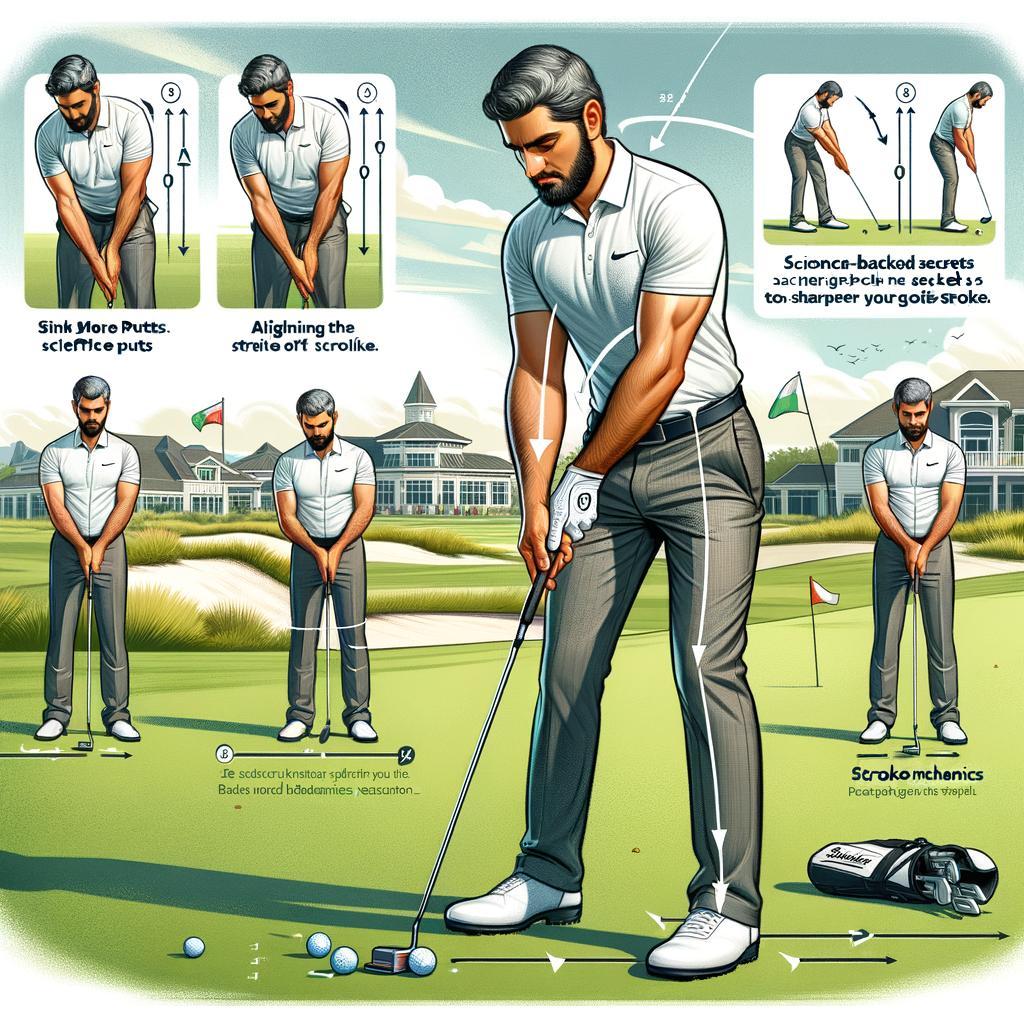
Sink More Putts: Science-Backed Secrets to Sharpen Your Golf Stroke
Grip & Setup: Build a Stable Foundation for the putting Stroke
Consistent putting starts with a stable,repeatable setup. Research and coaching consensus point to setup variables that reduce micro-movements and increase repeatability of the putter face at impact.
- Neutral,light grip pressure: Grip pressure should be light enough to allow the shoulders to drive the stroke and heavy enough to keep the clubhead connected. Excessive tension increases stroke variability.
- Shoulder-driven pendulum: Align shoulders and keep wrists quiet. A shoulder-driven stroke reduces the degrees of freedom in the system and lowers error.
- Eye position and posture: Position eyes over or just inside the ball line for consistent alignment. A balanced athletic posture stabilizes the torso and promotes a smoother pendulum action.
Setup Checklist
- Feet shoulder-width or slightly narrower
- Ball centered or slightly forward of centre
- Putter shaft leaning slightly toward target
- Relaxed neck and shoulders
alignment & Aiming: Where Science Meets Targeting
Missing the aim is wasted distance control. Effective alignment and aim reduce directional errors that cost pars.
- Pick a precise aim point: Use the leading edge of the putter, a seam on the ball, or a tiny grass blade. Precise visual anchors reduce uncertainty.
- Check posture alignment: Shoulders, hips and feet should be parallel to the intended target line for repeatable aim.
- Use an aiming routine: A two-step aim (macro aim then micro-aim) improves consistency under pressure.
Stroke Mechanics & Biomechanics: Reduce Variability
The most reliable putters minimize needless joints and control tempo. Motor learning science shows that reducing degrees of freedom (e.g., minimizing wrist action) improves consistency.
Key biomechanical principles
- Minimal wrist breakdown: Keep wrists firm to avoid flip or scooping at impact.
- Smooth acceleration through impact: Aim for a controlled forward acceleration so the ball rolls without skidding.
- Repeatable tempo: A consistent tempo produces better distance control than trying to “feel” the speed each time.
Tip: use a metronome app for tempo practice. Even top players use a cadence or internal count to keep pacing steady.
Green Reading & Putting Line strategy
Reading the green is both art and science. Combining slope, grain, speed, and your intended speed (pace) is critical for making putts.
Practical green-reading workflow
- Stand behind the ball and read the overall fall of the green from several angles.
- Walk the target line and look at the contours-low spots and ridges influence break more than you think.
- Decide on a speed first, then choose the line that will allow the ball to track through the hole at that speed.
systems like AimPoint (and other detection methods) give players a repeatable process for quantifying slope and putting speed. Whether you use a formal system or your visual instincts, the key is standardization: use the same method every time to reduce cognitive load and improve accuracy.
Attentional Control & The Psychology of Putting
Motor learning research shows that where you focus attention affects performance. An external focus (attending to the ball’s path or target) generally produces superior outcomes compared to an internal focus (attending to body parts).
- External focus: Think of the target line and the ball’s path rather than your wrists or arms.
- Quiet eye: hold your gaze on the target (or target spot on the hole) for a short period before and during the stroke-this improves targeting under pressure.
- Pre-shot routine: A consistent routine (visualize, align, breathe, stroke) decreases anxiety and improves automaticity.
practice Strategies Backed by Motor Learning
How you practice determines how you perform. Motor learning literature offers clear guidelines for effective putting practice:
- Purposeful practice: Short, focused sessions with specific targets beat mindless ball-hitting.
- Variable practice: Mix distances and breaks. Randomized drills increase adaptability and retention even if blocked practice feels easier in the short term.
- Feedback and reflection: Use objective feedback (make percentage, distance outcomes) and reflect on what changed between attempts.
Science-kind drills to include
| Drill | focus | Time |
|---|---|---|
| Gate Drill | Face control / path | 10 min |
| Distance Ladder | Distance control (3-15 ft) | 15 min |
| Pressure Circle | Short putts under pressure | 10-15 min |
Practical Drills (Step-by-Step)
1. Gate Drill - Improve Face Alignment
Place two tees slightly wider than the putter head and stroke through them without touching.Focus: square face and straight path. Repeat 50 strokes with a target of 90% clean passes.
2. Distance Ladder – Master Pace
Set targets at 3 ft, 6 ft, 9 ft, 12 ft, and 15 ft. Start at the closest and work out. For each target, try to hole or leave within a 3-foot circle.Track make rate and average leave distance.
3.Pressure Circle – Short Putt Combat
Put 6 balls in a 3-foot circle around the hole. Make all 6 in a row to “clear” the circle. This trains routine, pressure handling, and short-stick confidence.
Common Faults and How to Fix Them
- Flipping or scooping: Fix by strengthening shoulder-driven motion, use gate drill to force face control.
- Pulls and pushes: Check aim,eye position,and alignment-frequently enough not a mechanical issue but an aiming error.
- Inconsistent distance: Train tempo with a metronome and practice the distance ladder drill.
- Nervous yips: Simplify your routine, adopt an external focus, and practice under low-pressure progressive exposure.
Sample 30-Minute Putting Practice Plan
| Segment | Activity | Duration |
|---|---|---|
| Warm-up | 10 short putts inside 3 ft (gate drill) + alignment checks | 7 min |
| Distance work | Distance ladder (3-15 ft) | 12 min |
| Pressure | Pressure circle - make 6 in a row | 6 min |
| Cool-down | 3 longer lag putts focusing on pace | 5 min |
Benefits & Practical Tips for Immediate Enhancement
- Save strokes: Improved short-putt reliability lowers your score quickly.
- Confidence under pressure: A repeatable routine and practiced tempo reduce tension on the course.
- Transfer to course play: Variable practice builds the adaptability you need on different greens.
Speedy tips to start today:
- Use a metronome app for 10 minutes of tempo work.
- Make a one-line pre-shot routine and stick with it for 20 rounds.
- Video-record your stroke occasionally to detect excessive wrist or hip movement.
Case Study: Applying Science to a Weekend Golfer (illustrative)
Sam,a 14-handicap weekend player,reduced three-putts by focusing on two changes: tempo consistency and a pre-shot aiming routine. After 6 weeks of three 20-minute sessions/week using the distance ladder and Pressure Circle,Sam’s 3-10 ft make percentage rose by a noticeable margin during casual rounds. Key takeaway: focused, short, and variable practice produces measurable on-course improvement.
SEO keywords to Keep in Mind
When writing about your progress or creating notes for practice, use these natural keywords for better searchability:
- putting stroke
- golf putting tips
- green reading
- distance control
- putter alignment
- short game practice
- how to putt
Final Practical Checklist (Actionable)
- Create a 3-step pre-shot routine and practice it until automatic.
- Practice tempo for 10-15 minutes with a metronome twice per week.
- Do one variable-distance session and one pressure short-putt session per week.
- Record periodic baseline stats: make %, average leave distance, and 3-putt frequency.