
Mastering any coordinated motor task requires more than mere repetition; it demands control, refinement, and adaptability so that technique can be performed reliably across changing conditions. In golf, the follow-through – often treated as visual flourish - is in fact an informative biomechanical snapshot of everything that occurred before impact. Because the finish reveals how momentum was transmitted, how segments sequenced, and how balance was managed after contact, it becomes a practical focal point for performance betterment across putting, approach shots, and tee shots.
This piece takes a research-informed, biomechanical outlook on follow-through mechanics and their influence on repeatability, distance, and scoring. Integrating principles from kinematics, kinetics, and motor learning, it merges empirical measurement with coachable practice methods. Objective metrics (clubhead speed, launch angle, spin rate, stroke tempo, face angle at impact, center-of-pressure shifts) and tools (launch monitors, high-speed video, motion capture, pressure mats) provide the assessment backbone. Building from that foundation, the article prescribes validated drills and cueing progressions tailored to putting, mid- and full-iron swings, and drivers so technical change converts into measurable on-course gains.
What follows is a practical roadmap: (1) treat the follow-through as both diagnostic and corrective, (2) break down ideal mechanics by shot type, (3) define measurable assessment markers and testing routines, and (4) outline progressive practice plans that align with current evidence and coaching practice. By linking biomechanics, measurement, and applied coaching, this guide equips coaches and committed players to turn follow-through awareness into sustained increases in consistency, power, and scoring.
How follow-Through Works: Movement Patterns,Forces and momentum
Grasping how body segments and the club coordinate is the prerequisite for a purposeful finish. At the motion level, the classic kinematic sequence remains central: pelvis rotation (~40°-50°), shoulder/torso rotation (~80°-120° depending on adaptability and intent), followed by arm extension and wrist unhinging that accelerate the clubhead through contact. Maintain an appropriate spine tilt (~10°-15°) and a swing plane suited to the shot – flatter for long clubs and slightly steeper for irons. Practical setup cues include shoulder-width feet for mid-irons (wider for driver),a stable athletic posture,a controlled shoulder coil with minimal head sway,and a hips-first downswing initiation so the torso and arms can follow. Use a mirror or phone video to track shoulder turn and an inclinometer app to confirm spine tilt; aim to keep repeated swings within ±3° of your target posture to raise repeatability and scoring reliability.
Turning movement into speed and distance depends on force production.Kinetics explain how ground reaction forces (GRFs) and torques convert rotational separation into clubhead velocity. At transition, push into the ground with the rear foot to drive weight toward the lead side; for full shots this commonly results in roughly 70%-90% of body mass loading the front side after impact (individuals and shot types vary). Initiating hip rotation ahead of the shoulders creates a torque differential that stores elastic energy through the torso and releases it into the arms and club. To train this pathway, emphasize lower-body drive and hip clearance through drills such as:
- Split-step progression – small forward step with the lead foot through the downswing to feel lateral transfer;
- Band-resisted hip turns – 8-12 reps focusing on explosive hip separation while keeping the upper chest relatively quiet;
- Paused-impact reps – hold the impact posture for 2-3 seconds to program forward shaft lean and body alignment.
These exercises improve how efficiently energy flows to the ball, limit loss from premature release or sideways sway, and typically produce tighter dispersion and improved distance control in windy or firm-course play.
Efficient energy transfer requires a coordinated release and a committed finish that preserves momentum beyond impact. Think of the clubhead continuing past the ball rather than stopping at contact; that sensation implies ongoing acceleration into the finish rather than deceleration that cuts ball speed and widens dispersion. Technical goals include maintaining forward shaft lean of ~5°-10° at iron impact, keeping hand deceleration variability under ±0.1 g when measured with an inertial sensor, and achieving similar clubhead-speed profiles between the final 20% of the downswing and the opening 20% of the follow-through. Drills to ingrain these features:
- Impact-bag sequence – compress the bag and hold the finish to feel energy passage;
- Half-to-full-speed ladder – 10 reps at half speed, 10 at ~75%, 10 at full speed while checking finish consistency;
- Tempo metering – use a 3:1 backswing-to-downswing rhythm early in training to stabilize timing.
The short game and putting have contrasting requirements: the objective is predictable redirection of energy with very low variability, not maximum velocity. In putting,adopt a pendulum-like motion with limited wrist break and a neutral-to-slight-forward shaft lean to square the face and produce a controlled follow-through. For a typical 10-12 foot putt, a backswing that matches intended roll distance (often a 10-14 inch arc) and a 1:1 backswing-to-forward stroke ratio will support consistent pace. Useful checkpoints:
- Gate drill – run the putter through a narrow opening to reduce face rotation;
- Distance ladder – mark 5, 10 and 20 ft and practice matching roll from each backswing length;
- impact tape – confirm central strikes and tweak loft or setup as needed.
On sloped greens or blustery days, modestly alter follow-through length to change speed while keeping the face stable – a key course-management adaptation to avoid three-putts.
Pair biomechanics with equipment, strategy and mental routines to convert technique gains into lower scores. start with fundamentals: moderate grip pressure (around 4-6/10 by feel), club selection aligned with desired trajectory, and precise alignment to the target. Correct common faults with targeted interventions:
- Early extension - perform wall-hold drills to preserve hip flexion through impact;
- Casting/early release – use a towel-under-arm or wrist-tension cue to postpone release until the body has rotated;
- Deceleration through impact – practice accelerative half-swings and check that a consistent finish follows.
Schedule three focused practice blocks per week (20-40 minutes each) with measurable aims (for example, cut lateral dispersion on 7-iron shots to ±10 yards within four weeks, or hold a putting finish on 8/10 attempts from six feet). Add a pre-shot routine with a tempo cue (count or breath) and a vivid image of the intended follow-through – this brief mental rehearsal improves execution under pressure and helps align risk choices on the course. Combining precise kinematics, powerful kinetics and consistent energy transfer with intentional practice and on-course strategy turns the follow-through into a repeatable performance advantage.

Face Control and Hand Path: How the Finish Predicts Ball Flight
Face angle at and promptly after contact combined with the hands’ travel direction determine initial ball direction and curvature. At impact the clubface largely sets the launch direction, while the face-to-path discrepancy controls spin-induced curvature. As a practical guideline, target a face-to-path difference under 3° for near-straight shots, 3-6° for moderate draws or fades, and values above 6° for pronounced shaping. Use a launch monitor or impact tape to make these relationships measurable and actionable. Also respect equipment rules (USGA/R&A) – avoid modifications intended to artificially change face behaviour.
The follow-through is the most visible summary of what occurred at impact: a hands-and-shaft path that continues on-plane and a face that rotates predictably indicate a repeatable delivery. To produce that outcome, coordinate actions in sequence: a stable lower body initiating rotation, a controlled forearm release at impact, and arm extension toward the target so hands travel on an extension of the downswing plane. For less experienced golfers, focus on a finish with chest and belt buckle facing the target and hands above belt level; better players should refine timing so the lead wrist is flatter at impact and the forearms show smooth supination through the finish. Slow-motion rehearsal, mirror work and aiming for a follow-through hand path within ±10° of the target line on practice swings improves face-to-path consistency at impact.
Convert these principles into repeatable practice with drills that address both face orientation and hand-path continuity:
- Impact-tape sessions – short shots into a net using tape to confirm face behavior and adjust grip or release;
- Alignment-stick extension drill – place a stick on the ground down the target line and rehearse finishes where hands and shaft point along the stick’s extension;
- High-frame-rate video checks - record at ≥240 fps to visually assess face-to-path and set a goal of reducing variance to ≤2° across 30 shots;
- Impact-bag release – train forward hand path and hand pressure through contact.
Common problems: if shots begin left and continue left (for a right-hander), suspect an overly closed face relative to path or an early release; if thay start right and fade, inspect for an open face or outside-in swing path.
Setup, equipment and course tactics affect how you apply these mechanics. Loft, lie, grip size and shaft flex influence how easily a player can square the face and manage release; for example, an overly soft shaft may exaggerate rotation and deepen a draw in gusty conditions. During club fitting, ensure clubs produce a neutral face-to-path when swung with the intended grip and setup. On the course, employ shot shaping as part of risk management: facing a downwind par-5 with hazards left, slightly close the face and use an inside-out hand path to produce a controlled draw that avoids trouble. In crosswinds, plan a modest 1-3° face offset to counter drift while preserving a consistent finish pattern.
Create a structured practice-to-play pipeline: set session objectives such as reducing face-to-path standard deviation to ≤2° and constraining lateral dispersion under 10 yards at a set distance.Progress from impact-bag and alignment-stick repetitions to on-course simulations – e.g.,alternate-shot games where you commit to a specified finish and ball flight.Use multimodal feedback – video for visual learners, impact-bag or weighted implements for kinesthetic learners, and launch monitor numbers for analytical players. Add a brief pre-shot visualization of hand path and face angle; this mental rehearsal strengthens the link between technical execution and in-round decision-making, helping lower scores by producing more predictable ball flight and smarter management.
Putting follow-Through: Stroke Length,Rhythm and Low-Back Stability
Begin putting practice with a reproducible setup that protects the lower back and creates a stable base for a consistent finish.Maintain a neutral lumbar spine (avoid excessive arching or rounding), hinge at the hips so the torso tilts roughly 25°-35° from vertical, and keep knee flex around 10°-15°. Position the eyes directly over or slightly inside the ball to support target alignment and limit head motion. Use light grip pressure (2-4/10 by feel) to reduce wrist manipulation and keep that pressure constant through the follow-through. Remember that anchoring the putter to the body is not permitted under the Rules of Golf; if you use a longer shaft,adopt a non-anchored technique that still secures low-back stability via hip hinge and core bracing.
Match stroke length and tempo so the follow-through becomes a natural continuation of the backswing. For controlled distance, let the follow-through closely match the backswing - a 1:1 spatial parity produces steady roll. Timing recommendations vary: short putts often perform best near a 1:1 backswing-to-forward time ratio, while longer lag putts may approximate 2:1. Practicing with a metronome set between 60-72 bpm helps internalize tempo. Keep the putting arc compact – typically 1-3 inches lateral deviation for straight short putts - and hold face orientation within about ±2° to reduce sidespin. Aim for the ball to start forward-rolling within the first 6-12 inches of travel by promoting downward-to-forward contact and minimizing dynamic loft (static putter loft commonly ~3°-4°).
Efficient practice links setup, stroke length and follow-through to on-course outcomes. sample routine under varied green speeds:
- Gate challenge – place tees at the outside edges of the putter path and complete 30 strokes without striking a tee (target: 0 contacts in 30 attempts);
- Pendulum mirror drill – use a small mirror or phone camera to monitor stable eyes/shoulders and a square face (target ±2°);
- Ladder distance control – 10 reps from 3, 6, 10 and 20 ft, adjusting stroke so follow-through equals backswing; aim to cut average leaving distance by 30% in four weeks;
- Lag-to-target – from 50 ft, try to leave the ball inside a 3-ft circle on 8 of 10 attempts to lower three-putt rates.
These drills build reliable motor patterns linking stroke length to follow-through and improve pace control and one-putt frequency.
Troubleshoot setup and equipment systematically:
- Wrist motion: excessive hinge creates variability – consider a firmer, more palm-to-palm connection (e.g., reverse-overlap or claw variants) to limit wrist break;
- Posture collapse: if the low back rounds, shorten putter length by 0.5-1.0 in or increase hip hinge to restore spacing;
- Putter specifications: verify lie and length with a fitter – an incorrect lie changes dynamic loft and face presentation through impact.
For players with low-back issues, add off-green stability work (dead-bug, bird-dog, side-plank progressions twice weekly). If mobility is limited,prefer a shorter backswing and a slightly firmer tempo rather than forcing longer strokes that drive compensations.
Convert practice gains to pressure performance by practicing situational adjustments and cementing a pre-putt routine: read the line,make a practice stroke to the target,set the grip and execute. On downhill fast greens shorten both backswing and follow-through and keep the face square; on uphill or into grain,lengthen proportionally while maintaining the same tempo. Set measurable in-round goals (for example,halve three-putts across eight rounds or reach >90% conversion from inside six feet) to track transfer. By combining technical putting mechanics, structured drills, correct equipment and clear on-course routines, players can systematically raise pace control, protect the low back and improve scoring outcomes around the hole.
Driving: Sequencing, Hip rotation and Finishes That Preserve Control
Efficient driving begins with a clear kinetic sequence: pelvis initiates the downswing, the torso follows, and hands/forearms accelerate the club into impact. Target a trail-hip coil near 45° on the backswing and an explosive but sequenced unwinding through contact to create maximal clubhead speed while retaining control. Practically, the trail knee should make a small lateral “bump” toward the target at transition, hips rotate before shoulders, and the arms channel the rotational energy rather than driving it. Evaluate the finish – a balanced end with the belt buckle facing the target reliably signals correct lower-body sequencing.
Start sessions with setup values that favor good sequencing: roughly shoulder-width stance for driver (1-2 in narrower for irons), slight toe flare (~10-15° front foot, 5-10° trail foot) to permit hip rotation, and a weight distribution of about 30-40% on the trail leg at the top moving to ~60-70% at impact, finishing near 90-95% on the lead leg. Checklist items to rehearse:
- Pelvic hinge at address – feel balance on the balls of the feet;
- Neutral spine – prevent early extension by keeping your posture through the swing;
- Head and chest posture in the finish – a lifted chest indicates proper hip clearance.
These checkpoints let coaches quantify progress and avoid common setup errors that undermine rotation and distance.
drills for reliable sequencing include:
- Step-through progression – half swings stepping the lead foot forward during downswing to reinforce weight transfer;
- Medicine-ball rotational throws – explosive sets for separation and power progress;
- Alignment-stick hip-turn drill – slow repetitions emphasizing hips leading shoulders.
A practical set might be 10 explosive throws, 20 slow alignment-stick reps, and 30 full swings with a tempo target (e.g., 3:1 backswing-to-downswing) measured with a metronome or app. Trackable objectives include adding +2-4 mph to clubhead speed over eight weeks, reducing lateral slide by 50% via video analysis, or holding a finish with belt buckle to target within 5° on 8/10 swings.
Typical faults that masquerade as power deficits – early hip clearance, lateral slide, or excessive upper-body rotation without lower-body engagement – respond to targeted fixes. Try these corrections:
- Place a low object behind the trail hip to prevent excessive lateral slide;
- Use a towel between the arms to limit shoulder turn and promote hip-first sequencing;
- Practice slow-motion swings to feel lead-hip rotation preceding arm acceleration by ~0.12-0.18 s (video can quantify timing).
Also account for equipment: shaft flex, club length and lie angle must match your mechanics – mismatched gear forces compensations that disrupt hip rotation and control.
On-course application: in wind or on firm fairways, slightly earlier hip closure producing a lower trajectory can improve control; on softer courses use fuller rotation to take advantage of stopping power from spin. Use a pre-shot visualization of hip lead and a balanced finish for 3-5 seconds and adopt situational rules such as using 70-80% rotation on tight fairways to prioritize accuracy or full rotation when distance is the main priority. for players with physical limitations favor hybrid strategies – moderated hip rotation with increased hand release or a greater emphasis on lower-body stability – to preserve control. Through coherent integration of biomechanics, drills, equipment checks and mental cues, golfers can increase driving distance without surrendering accuracy.
Drills & Routines: Building a Balanced, Repeatable Finish for All Strokes
Begin with a concise technical baseline so follow-through development is framed by measurable outcomes. Verify setup fundamentals: feet shoulder-width, ball position appropriate to the club (mid-stance for irons, forward for long clubs), spine angle preserved during swings (often ~15°-20° forward tilt for full swings), and initial weight around 60% lead / 40% trail. Capture five swings on video (120 fps if available) to quantify finish positions – chest and beltware orientation, lead knee flex and weight transfer, shaft wrap over the lead shoulder, and balance duration on the front foot. Use that baseline to set targets (such as, hold a balanced finish for 3-5 s on 8/10 swings) and guide progressive work that treats the follow-through as the continuation of impact mechanics, not a separate motion.
For full-swing reinforcement, do balance-plus-sequencing drills with clear pass/fail criteria:
- Mirror finish hold - slow ¾ swings, hold the finish for 5 s; aim to load ~90% of weight on the lead foot and have the shaft point to or slightly left of the target (right-handers);
- Step-through drill – swing to contact then step the trail foot through to finish naturally on the lead foot, repeat in 10-shot sets;
- Hip-pause – stop at hip height on the follow-through for 2 s to train coil release and timing.
Only ramp speed once you reach a target hold rate (e.g., 8/10). Common issues – trail-shoulder collapse, pivot reversal, forward head movement – can be fixed with tactile cues (towel under the trail armpit) and immediate video feedback.
Short-game shots require scaled finishes related to required trajectory. chips, pitches and bunker shots use different follow-through lengths tied to distance and loft:
- Hands-forward contact – place a 3-5 cm towel ahead of the ball to promote crisp contact and a concise follow-through;
- controlled-acceleration ladder – hit sequential targets at 10, 20 and 30 yards, lengthening follow-through with distance and measuring carry/roll correlations.
These exercises help link follow-through length to scoring around the green and inform strategic choices (e.g., choose a lower-trajectory chip with a shorter finish on firm surfaces).
Putting finishes emphasize face control and matched stroke length rather than aggressive wrap. Reinforce a pendulum action where follow-through mirrors the backswing (≈1:1 for short putts; slightly longer follow-through on lag attempts) using:
- Tape-and-gate – mark a thin tape line on the putter face and a tight gate to ensure square travel; target face alignment within ±5° at impact;
- Metronome strokes – 60-80 bpm to sync backswing and follow-through; log make percentage at 3,6 and 12 ft.
Adjust follow-through for conditions: shorten into wind or on firm greens to lower launch; allow fuller follow-through on soft surfaces to increase rollout predictability. Check putter lie and grip thickness on the practice green before applying changes in competition.
Structure weekly practice to blend technical repetition with course-style pressure: 15 minutes mobility/setup checks, 30 minutes of focused drill blocks across full swing, short game and putting (each with measurable targets), and 20 minutes of pressure simulations (e.g., make 8 of 10 finishes under a time limit). Include visual (video comparison), kinesthetic (towel/alignment stick), and auditory (counted tempo) modes of feedback to reach different learner types. Use troubleshooting checkpoints:
- Is finish balance held for the target duration?
- Does the clubface at impact match the intended shot shape?
- Are dispersion and distance control improving across 50-100 shots?
Set measurable objectives (for example: reduce lateral dispersion by 20% and achieve balanced finishes on 80% of swings within four weeks) and verify progress with video and launch monitor data. Combining biomechanical consistency with course strategy and mental routines allows golfers to turn a stable follow-through into lower scores across driving, approach play and putting.
Objective Measures: Club Speed,Face Angle and Body Rotation
Reliable baseline testing underpins any evidence-guided training program. Use a calibrated launch monitor (TrackMan/GCQuad-style) and high-frame-rate video from two viewpoints (down-the-line and face-on). Capture at least 20 swings with your driver and a mid-iron to compute means and standard deviations for key metrics – this yields a consistency profile rather than a one-shot best. Short-term targets might include gaining +3-5 mph clubhead speed in three months or tightening face-angle variability to within ±2° at impact.Confirm equipment conforms to governing standards so changes reflect technique rather than gear mismatch.
Clubhead speed is both a power and control indicator.Follow a repeatable testing protocol (same ball, tee height, warm-up routine) and average across swings. Recent launch-monitor datasets (2023-2025) show typical male amateur driver speeds clustering near 88-96 mph, female amateurs frequently enough between 68-76 mph, while low-handicap amateurs and many touring professionals commonly exceed 100 mph.To raise speed safely employ progressive training: overspeed swings (lighter implements for 8-12 reps), strength-speed work (medicine-ball rotational throws, 3×8), and tempo drills (metronome 60-70 bpm). Track transfer by monitoring ball speed and smash factor – if ball speed rises but face control suffers, prioritize control-focused drills before increasing full-speed volume.
Face angle at impact predominantly determines initial direction and dispersion. Use a launch monitor with face-to-path outputs and validate with impact tape or face-on video. Aim for a face angle within ±2° of square for approach shots and similar tolerances for drivers when accuracy is paramount. Corrective methods include the gate drill, impact-bag compression focusing on a square face, and slow half-swings with an alignment stick near the toe to visually assess rotation. For beginners, simplify instructions to “lead with chest, let hands follow.” Advanced players can fine-tune with subtle grip rotation or wrist set changes to eliminate remaining degrees of error.
Body rotation metrics (shoulder turn, pelvic rotation, X‑factor) are best captured via high-speed video or wearable IMUs. Typical effective ranges: 80-100° shoulder turn (men), hip rotation ~40-50° and an X‑factor near 20-30° at the top. To assess sequencing, examine pelvis rotation timing relative to clubhead acceleration - premature pelvic clearance reduces lag and clubhead speed, while delayed hip drive limits power. Refine rotation with L‑to‑L drills, medicine-ball throws and step-through reps; confirm learning by holding the finish for two seconds to verify balanced chest orientation toward the target – a reliable correlate of consistent impact geometry.
Make metrics drive practice and on-course choices: test every 6-8 weeks, use targeted technical blocks (two weeks on face control, two on rotation), and maintain tempo and short-game sessions. Use in-round heuristics – for instance, if driver face variability exceeds ±3°, choose a 3‑wood or controlled long iron from tight tees; in crosswinds, reducing clubhead speed by 5-8 mph can lower spin and trajectory. Troubleshooting checklist:
- Setup: ball position, posture, grip tension;
- Face vs. path: determine whether misses are driven by the path or by face orientation;
- Finish: consistent chest rotation and lead-foot pressure.
by iterating measurement, structured drills and on-course application, players can convert numeric feedback into better consistency, smarter club choices and lower scores.
Physical Planning and Injury Prevention to Sustain the Finish
Biomechanical efficiency underpins a follow-through that is both powerful and durable – so conditioning and injury prevention must address the kinetic chain from feet to shoulders. Typical safe ranges to support technique: a full shoulder turn near 90°, maintained spine tilt ~10-20° through impact, and hip rotation of 40-50° toward the target in a full finish. Staying within these ranges reduces compensations that cause low-back strain, shoulder overload or elbow tendinopathy. Reinforce a controlled deceleration after impact so hands and club are guided by body rotation rather than isolated arm forces; that sequencing lowers repetitive stress and sustains ball-striking under fatigue.
Progressive conditioning should combine mobility, stability and strength for all golfers. A brief dynamic warm-up (8-12 minutes) before play can include: 3-5 shoulder circles, 10-12 thoracic rotations per side, 10 leg swings per leg, and 30-60 seconds of band-resisted external rotation. A 2-3×/week strength plan might incorporate glute bridges (3×12), single-leg Romanian deadlifts (3×8 per leg) and anti-rotation cable chops (3×10 per side). Mobility benchmarks such as 45-60° thoracic rotation and 30-45° hip internal/external rotation within 6-8 weeks support safer finishing mechanics and reduce abrupt lumbar torque in course scenarios (e.g., punch shots under trees).
Translate conditioning to the range with measurable drills:
- Finish-hold drill – 30 half-swings with a 3-second finish on ≥80% of reps to train balance and deceleration;
- Step-through sets – 3×10 to force weight transfer and engrain lower-body sequencing;
- Towel-under-arm connection – 2×15 swings to maintain arm-torso connection and delay early release;
- Medicine-ball rotations – 3×8 explosive throws to develop safe rotational power.
Also verify fundamentals each session: shoulder-width stance, ball forward of center for long irons, neutral grip pressure and ~15° spine angle at address.
Correct common technical faults with progressive steps and consider equipment influences. For early release or reverse pivot use slow-motion swings and impact-bag strikes to restore lag and weight transfer; cue a compact wrist hinge (~45° at the top) for many amateurs. If balance fails at the finish, temporarily reduce shaft length by 0.5-1.0 in or reassess grip size – both can lessen forearm strain. Advanced players may benefit from minor shaft-flex or lie tweaks after a professional fitting, but avoid self-modification.If pain persists, stop high-load drills and seek sports-medicine advice - training through pain often creates longer-term setbacks.
Match conditioning and technique with adaptive course choices: on fatigued days or in adverse weather favor lower-trajectory shots and briefer finishes into the wind to reduce torque. Set measurable short-term targets like holding a balanced finish on 70-80% of practice swings within 6-8 weeks and monitor on-course proxies such as fairways hit and greens-in-regulation.weekly video or coach-led checks help track tempo and finish. By aligning mobility and strength training with deliberate sequencing practice and sensible on-course decisions, players from beginners to low-handicaps can keep a consistent follow-through, limit injury risk and turn mechanical gains into fewer strokes.
Feedback Systems: Coaching cues, video Review and Progressive Practice
Effective improvement depends on systematic feedback: combine concise coaching cues with objective video and baseline metrics. Start each assessment with standardized checks – moderate grip pressure,appropriate stance width (shoulder-width for full shots),and a subtle spine tilt (roughly 3-5° away from the target at address). Use two camera angles (down-the-line ~6-8 ft behind at shaft height and face-on ~8-12 ft to the side) and record at ≥60 fps (preferably 120 fps for wrist and release details). Define measurable aims like reducing face variability to ±2° or producing 8/10 strikes inside a 10-yard dispersion. Annotate video frame-by-frame with prioritized cues (e.g., “maintain spine angle through impact”) so the player has a concise practice prescription.
Use the follow-through as both assessment and training target: a good finish reflects path, release and balance. Coach players to reach a balanced end with about 70/30 lead-foot pressure, shoulders rotated so the chest faces the target, and hands extended for 1-2 s after impact – signs of correct extension and release.Technical targets can include hip rotation of 45°-60° from address to finish and a maintained wrist hinge roughly 90° relative to the lead forearm near the top for players using a standard hinge. Address common faults (early release, loss of lag, collapse) with drills such as impact-bag compression, pause-at-impact reps and toe‑up/toe‑down release work. Tailor the emphasis: novices prioritize balance and tempo, advanced players refine release timing and face control for shot shaping.
Blend short-game skill and green-reading with follow-through mechanics to reduce scores. For putting, emphasize minimal wrist action, eyes over the ball and a finishing traverse of the putter head for 1-2 clubhead lengths; remember anchors are not allowed, so favor free-arm strokes. For chipping and pitching, use a narrower stance and ball slightly back of center for bump-and-run shots, and a more vertical follow-through for high-loft wedges to control descent and spin. Useful practice tools:
- Gate drill for face square at impact;
- Distance ladder for landing spots at 10, 20 and 30 yards;
- Green simulation across three slopes to practice speed control and break reading.
Set outcomes (e.g., improve up-and-down rate by 10-20% or reduce three-putts to ≤1 per round over 6-8 weeks).
design progressive microcycles that move from isolated technique to integrated, pressure-laden scenarios. A representative four-week block might include two technical range sessions (drills + video),one short-game block (30-45 minutes),and one on-course session emphasizing decisions under variable conditions. Use phases – assessment (week 1),technical correction (weeks 2-3),transfer (week 4) – then reassess.Assign measurable workload goals (e.g., 250 monitored ballstrikes per week, achieve 7/10 shots within 15 yards at a 150-yard target, maintain a backswing-to-downswing ~3:1). When progress stalls, apply a simple checklist:
- Was setup consistent across reps?
- Did video reflect the intended finish?
- Are club specs altering ball flight?
This structure promotes transfer from practice to competition and ensures gains are measurable.
embed course strategy,situational play and mental routines into the feedback loop. teach players to combine carry and roll when selecting clubs (e.g., add 2-3 clubs into firm, windy conditions) and use shot shape as a risk-management tool around doglegs and hazards.Reinforce rules awareness (unplayable lie options, relief from lateral hazards) to optimize choices. For mental skills, use pre-shot checklists, visualization of intended finish and pressure drills (countdown to swing, simulated match-play) to build resilience. Provide varied coaching pathways to suit learning styles – kinesthetic players get weighted implements, visual learners receive annotated video models, and analytical players use dashboards and progress charts. Repeating cycles of video feedback, concise cues and realistic practice converts technical improvements into lower scores and consistent on-course performance.
Q&A
Preface – what “master” means here
– In the title “Master the Follow-Through,” the word “master” denotes achieving reliable, evidence-based command of follow-through mechanics – consistent, reproducible competence in delivering the intended finish across putting, swing shots and driving.
Q1: What exactly is the follow-through and why does it matter?
A1: The follow-through is the movement phase after ball contact that completes the motion chain. It reflects the quality of sequencing, energy transfer and balance. In full swings and drives the finish signals correct weight transfer, deceleration control and completed rotation – all factors that affect clubhead speed, face presentation at impact and dispersion. In putting the follow-through governs consistency of face square,stroke tempo and distance control. Biomechanically, the finish is an observable manifestation of internal torques, GRFs and intersegmental timing, making it diagnostic for both performance and injury risk.
Q2: Wich biomechanical laws underpin an effective follow-through?
A2: main principles:
– Proximal-to-distal sequencing: energy should flow from torso to forearms to club/putter.
– Controlled deceleration: eccentric control of distal segments limits premature release and face rotation.
– COM transfer and GRF management: effective lateral and vertical forces provide a stable base and power.
– Kinematic repeatability: consistent joint angles, tempo and impact geometry yield stable results.
– Balanced finish: a stable end position indicates appropriate momentum absorption and minimal compensatory motion.
Q3: How do follow-through demands differ across putting, full swing and driving?
A3: Intent and equipment change the biomechanical target:
– Putting: low-speed, pendulum stroke; priority is face stability and minimal wrist action.
– Full swing: moderate to high speed; priority is lag retention, sequence integrity and controlled deceleration.
– driving: maximal speed and torque; higher grfs and pelvis/torso dissociation demand advanced eccentric control to absorb forces safely.
Q4: What objective metrics best capture follow-through quality?
A4: Useful indicators include: clubhead and ball speed, smash factor, face angle and rotation, club path and attack angle, post-impact shaft lean and hand position, tempo ratios and stroke length for putting, GRFs/weight shift, segmental angular velocities (IMUs/motion capture), and strike location on the face (impact tape).
Q5: Evidence-based drills for full-swing follow-through?
A5: High-value drills:
– Towel-under-arms – promotes connection and torso-led motion.
– Impact-bag – teaches compression and forward shaft lean.- One-arm slow swings (lead arm) – isolates sequencing.- Medicine-ball rotational throws – builds torso-pelvis dissociation and explosive sequencing.
– Finish-hold with mirror/video – reinforces balance and kinesthetic awareness.
For each drill capture baseline metrics and set measurable pass/fail thresholds (e.g., cut face rotation by 1-2° or center strikes within 10-15 mm).
Q6: Putting drills for consistent follow-through and pace?
A6: high-return practices:
– Pendulum mirror work – enforces minimal wrist action and face square; quantify via high-speed video or small sensors.
– gate drill – enforces center strikes and straight follow-through.
– Length-matched strokes – practise equal backswing and follow-through for pace control; measure deviations from intended roll.
– Metronome work – stabilizes backswing-to-forward timing; log stroke timing variability with a putter-mounted accelerometer.
Q7: How should progress be monitored?
A7: Protocol:
– Baseline capture: 20-30 swings/putts with launch monitor/video/IMU.- Pick 3-5 target metrics (clubhead speed, face rotation, strike dispersion, putt speed variability).
– Re-test weekly or biweekly under consistent conditions and track means and standard deviations.
– Use moving averages and confidence intervals to detect trends and combine quantitative data with video review.
Q8: Common faults and swift corrective cues?
A8: Typical issues and cues:
– Early release: cue “maintain lag”; use towel or impact-bag to feel delay.
– Closed face through impact: cue “square the face”; practice pauses at impact.
– Hanging back: cue “step-through”; use stepping drills.
– Excessive lateral sway: cue “rotate on axis”; place an alignment stick to discourage lateral movement.
– Abrupt putting finishes: cue “finish the stroke”; use length-matched drills and metronome timing.
Q9: How does a better follow-through lower scores?
A9: Mechanisms include improved strike consistency (less dispersion), better face control (fewer directional errors), enhanced putting distance control (fewer three-putts), and greater power efficiency (higher smash factor), which can shorten approach distances and increase scoring chances. The magnitude of strokes-gained gains depends on the player’s baseline, but consistency and distance control improvements reliably translate into measurable scoring benefits.
Q10: How to periodize practice for follow-through improvements?
A10: Suggested stages:
– Phase 1 (Technique, 2-4 weeks): slow, deliberate reps with enhanced feedback.
– Phase 2 (Integration, 4-6 weeks): increase speed, introduce variability and target objective metrics.
– Phase 3 (Transfer, ongoing): competition simulations, pressure drills and conditioning for sustained performance.
Mix low-speed control work with high-velocity practice while reinforcing shared sequencing principles.
Q11-Q20 (short summaries)
– Conditioning, mobility and eccentric control are essential for safe, repeatable follow-through mechanics.
– Practical measurement tools: launch monitors, high-speed smartphone video (120-240 fps), IMUs and pressure mats.
– design drills with measurable targets, progress by decreasing feedback and increasing variability/pressure.
– Adapt coaching to age and experience: novices need simplified patterns, intermediates refine sequencing, older players prioritize mobility and load management.
– Report data in coaching/research with methods, metrics (means, SDs), effect sizes and practical linkage to on-course outcomes.
– Expected timelines: neuromotor gains in 2-6 weeks; strength/power changes in 6-12 weeks; scoring translation over months.
– Shared drills can transfer principles across putting and driving, but each domain needs specific drills as well.
– Use A/B testing with objective metrics to resolve conflicting cue recommendations.
– Key research gaps: longitudinal studies linking follow-through protocols to strokes-gained, eccentric deceleration strategies for injury reduction, validation of low-cost wearables in the field, and motor-learning experiments tailored to follow-through acquisition.
Practical session checklist:
- Baseline capture: 15-30 reps (video + metrics).
- Choose 1-2 target metrics and a primary cue.
- run 2-3 drills with immediate feedback and pass/fail criteria.
- Record post-drill metrics and compare to baseline.
- Assign home practice with measurable goals and a re-test schedule (weekly/biweekly).
- Integrate conditioning if mobility or eccentric strength deficits are found.
Closing observation: mastering the follow-through blends biomechanical insight, objective measurement and deliberate practice. Use measurable targets, progressive drills and consistent feedback loops to shape the follow-through across putting, approach play and driving while monitoring transfer to competition and guarding against injury.
Wrapping Up
Seeing the follow-through as a unifying, measurable construct links efficient biomechanics with improved on-course performance. The finish is not merely cosmetic – it is the kinematic expression of sequencing, energy transfer and face control. When the kinetic chain, center-of-mass management and distal timing are aligned, players produce more consistent face orientation, repeatable launch conditions and reduced outcome variability. Conversely, a flawed finish frequently signals upstream defects – poor weight shift, truncated rotation, or inconsistent wrist action – that manifest as power loss, directional error and higher scores.
The evidence-aligned drills and diagnostic metrics outlined here create a clear pathway from assessment to intervention. Objective measures (clubhead and ball speed, smash factor, face angle, putter-path metrics and dispersion statistics) combined with video and GRF monitoring allow coaches and players to quantify baseline function and monitor change. progressive, context-sensitive practice – beginning with low-load motor patterning and progressing to full-speed, pressure-simulated reps – fosters lasting motor learning and competition transfer. program design should be individualized, accounting for anthropometrics, injury history and performance goals, and integrated into a periodized plan.
For practitioners and researchers, the follow-through remains a productive domain for further study. Longitudinal intervention trials, fatigue-and-recovery effects on finish fidelity, and equipment-biomechanics interactions will help clarify how follow-through mechanics convert into strokes-gained. Meanwhile, coaches should emphasize measurable, repeatable follow-through indicators and maintain an iterative assessment-intervention cycle to optimize power and consistency.
Adopting a deliberate, metrics-driven approach elevates the follow-through from an observational end point to a diagnostic and developmental tool - one that, when aligned with solid biomechanical principles and evidence-based practice, can materially improve swing efficiency, putting reliability and driving performance.
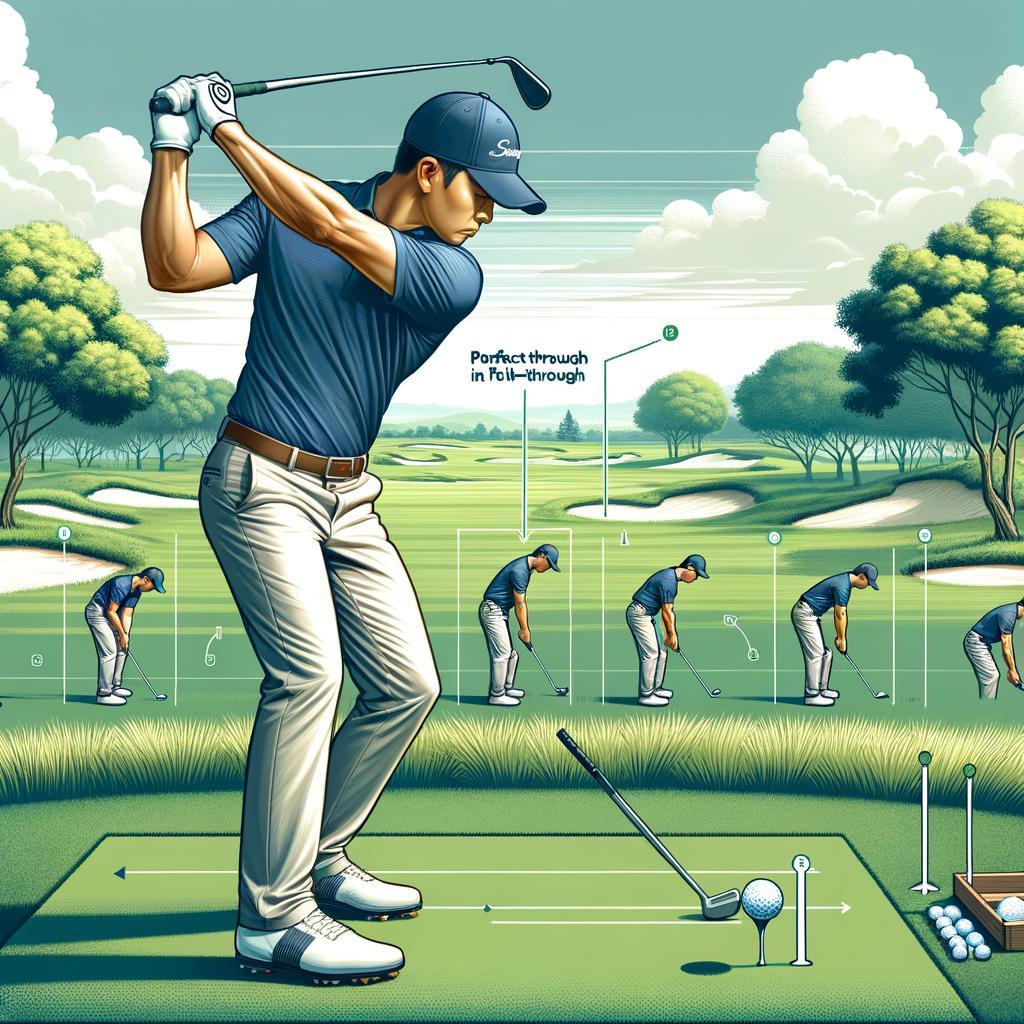
Unlock Your Best Golf: The Science-Backed Guide to Perfecting Follow-Through in Swing, putting & Driving
why follow-through matters: biomechanics, ball flight & consistency
Follow-through is not a cosmetic finish - it’s the kinematic fingerprint of the motion that created impact. The way your body continues to move after contact reveals whether you built and delivered energy efficiently, maintained clubface control, and completed proper weight transfer. Biomechanics and golf science show that a repeatable follow-through correlates strongly with consistent ball striking, better launch conditions, improved driving accuracy, and steadier putting results.
- Kinematic sequence: Efficient transfer of energy starts from the ground (ground reaction forces) → legs → hips → torso → arms → club.A correct follow-through reflects a correct sequence at impact.
- Clubface control: A smooth extension and release stabilizes face angle through and after impact,improving direction and reducing side spin.
- Balance and tempo: A balanced finish shows good tempo and rhythm – vital for reliable distance and shot shape.
How follow-through differs: Swing, Putting & Driving
Full swing (irons & hybrids)
For iron shots you want a compact, controlled follow-through: balanced on the lead leg, chest facing the target, arms extended but not rigid. The finish should show full shoulder rotation with the hips square or slightly open to the target. A compact finish usually results from a solid strike and correct center-of-mass shift.
Driving (driver & long clubs)
Driver follow-through emphasizes width, extension and late release to maximize clubhead speed while maintaining direction. You should see a powerful hip turn, higher finish posture due to fuller extension, and natural weight transfer to the front foot. Too early deceleration or collapsing the torso leads to blocked drives or hooks.
Putting
Putting follow-through is about maintaining face angle and stroke path. A proper follow-through in putting often looks like a quiet, pendulum extension where the putter head keeps the same arc and the face remains square relative to the path. For longer putts, the follow-through is longer and smoother; for short putts, it’s shorter but identical in path and face control.
Key mechanics & cues for a reliable finish
- Finish position: Balanced on the lead foot, torso rotated toward the target, eyes following the ball line, and the club pointing toward the target area (not behind you).
- Extension over rotation: Maintain arm extension through impact while allowing the torso to rotate; extension controls contact while rotation adds speed.
- Soft release: Let the wrists unhinge naturally – forcing release causes timing errors.
- Tempo first: Smooth backswing and transition prevents late deceleration during follow-through.
- Head control: Hold a stable head through impact then allow a natural follow with the body - sudden head movements create mis-hits.
Rapid cue: “Finish tall, chest to target, arms long” – a simple mental image to check extension and rotation.
Progressive drills to build a repeatable follow-through
Use a progressive learning plan: motor pattern → drill → feedback → consolidation on course. Below are high-value drills for each area with progressions.
Drills for full swing follow-through
- Chair-Behind-Lead-Foot Drill - Place a chair or alignment stick behind your lead foot. Practice swings finishing balanced on the lead leg without the chair being hit. Purpose: encourages weight transfer and balance.
- 3/4 to Full Swing Ramp – Start with 3/4 swings focusing on full hip turn and a controlled finish, then increase to full swings after 10 reps. Purpose: builds sequence consistency without overswinging.
- Slow-Motion Overspeed - Make slow swings focusing on perfect follow-through, then perform slightly faster swings while keeping the same finish. Purpose: train the nervous system for the ideal pattern at different speeds.
Drills for driving follow-through
- Alignment Stick Width Drill – Place an alignment stick parallel to the target, then another parallel behind to indicate the desired swing arc. Practice wide takeaway and a full extension finish.
- Step-and-Swing – Step toward the target with the lead foot at impact to exaggerate weight transfer, then swing to a balanced finish. Helps generate forward momentum and proper driving extension.
- Football Toss Balance – Toss a small medicine ball or soft football up during the finish to reinforce a stable, upright finish – useful for explosive drivers.
Drills for putting follow-through
- Gate Drill – Use two tees to create a gate slightly wider than the putter head to force a square face through the stroke and consistent follow-through.
- Metered Pendulum – Count a 1-2-3 tempo where 1 = backstroke, 2 = transition, 3 = follow-through. Keep length of backstroke and follow-through equal for distance control.
- Train the Arc - Place a string or towel under both hands and make strokes while keeping hands and forearms moving together to maintain a stable path and follow-through.
Practice plan & sample week (frequency, sets, reps)
Consistency beats volume. Short, focused sessions with feedback produce quicker improvement than random hours on the range.
| Day | Focus | Duration | Key Drill |
|---|---|---|---|
| Mon | Putting (control & follow-through) | 30 min | Gate Drill + Metered Pendulum |
| Wed | Irons (balanced finish) | 45 min | Chair-Behind-Lead-Foot + 3/4 Ramp |
| Sat | Driving (extension & speed) | 45 min | Alignment stick Width + Step-and-Swing |
Tip: Finish every session with 5 controlled swings focusing onyl on a perfect finish – muscle memory builds on the final repetitions.
Feedback tools & technology that accelerate improvement
- Slow-motion video: Record from down-the-line and face-on to assess finish and rotation.
- Launch monitor: Measures launch angle, spin, face angle and can show correlation between follow-through changes and ball flight.
- Impact tape / spray: Shows strike location – helps you connect follow-through with where you hit the face.
- Putting lasers & training aids: Force the face and arc to remain square through impact and into follow-through.
Common faults, causes & fixes
| Fault | Likely cause | Quick fix |
|---|---|---|
| Early release / flip | Wrist breakdown or reverse pivot | Hold lag with a towel under arm; focus on rotation rather of hands |
| Falling back / off-balance finish | Poor weight transfer or deceleration | Chair-behind-lead-foot drill; practice finishing on front foot |
| Open face at finish (slices) | Outside-in path or weak release | Path drills + stronger connection between torso and arms |
| Putting stroke stops after impact | Fear of three-putt; inconsistent tempo | Metered pendulum rhythm; practice long putt follow-throughs |
measurable benefits of a better follow-through
- More consistent launch conditions (angle, spin, direction)
- Greater clubhead speed and distance, especially with driver
- Improved shot dispersion and lower scores (fewer penalty strokes)
- Better putting distance control and fewer three-putts
case study: From inconsistent contact to repeatable finish
Amateur golfer “A” averaged 45 putts per round and inconsistent iron strikes. After six weeks of focused follow-through training (three 30-45-minute sessions per week), including meter pendulum putting work and chair-behind-lead-foot iron drills, the player achieved:
- 10-15% reduction in putts per round
- Improved impact location (less toe and heel misses)
- Stronger confidence on driver tee shots due to stable finish and increased clubhead speed
This demonstrates how targeted follow-through work transfers directly to measurable on-course improvements.
First-hand practice notes (what to expect when you start)
when you begin drilling follow-through, expect immediate awareness changes: your finish will feel different, and ball flight may change. Early on, results can be inconsistent as your nervous system adapts. keep thes expectations in mind:
- short-term: feel changes and occasional improved strikes.
- Medium-term (2-6 weeks): more consistent impact, better distance control.
- Long-term (6+ weeks): automatic finishes that translate to competitive rounds.
On-course request: when to think about follow-through
- Use a quick finish check on every tee shot and approach to ensure balance.
- During putts,visualize a matched backstroke and follow-through to control distance.
- If under pressure, shorten your practice swing but keep the same finish feeling to preserve your sequence.
Simple pre-shot finish checklist
- Weight slightly favoring lead foot at setup (driver slightly more even).
- Visualize a balanced finish toward the target.
- Commit to a smooth tempo – don’t decelerate through impact.
- Finish tall with chest toward target and arms extended.
SEO keywords used in this article
Primary keywords included naturally: golf follow-through, swing follow through, putting follow-through, driving follow-through, golf swing mechanics, putting stroke, driving accuracy, golf drills, weight transfer, extension and release.